 061 655 2994
MSS Blog
Is it even a thing to improve your sex life…? Part1

Sep
With a long-term relationship or marriage what often pays the highest price, is yes, you guessed it, unfortunately your “SEX LIFE” …
So, ask yourself, are you having enough sex and are you having the best sex? I don’t know about you, but isn’t that kinda the point of a #relationship or #marriage? And isn’t it supposed to get more earth shattering the longer you stay together? Apparently, that’s incorrect… According to Worldmetrics.org Sex in Marriage Statistics 2026, 41% of married couples worldwide have sex less than once a month. Scary! But it gets worse, several factors were found to affect sex frequency in a study conducted by the Indiana University National Survey of Sexual Health and Behavior 2024 namely:
- Medical e.g. hypertension and SSRI medication reduce desire
- Hormonal drops in testosterone and estrogen will reduce desire
- Bandwidth explained as career stress, parenting and financial strain to name a few all reduce desire
- Habit e.g. avoidance of sex patterns for what ever reason, all affect desire responsiveness negatively
- Relationship factors e.g. unresolved conflict, emotional distance and poor communication do the exact same thing…
And then there’s getting older a common factor leading to a decrease in sexual frequency. A 2020 survey showed the sharpest drop in sexual frequency was after the age of 50, according to scienceinsights.org – How Often Do Couples Have Sex? Stats and Norms 2026. A surprising study from the University of Toronto in 2015 (Muise et al., replicated 2023), found relationship satisfaction increased with sexual frequency up to about once per week and then plateaus. Couples engaging in more frequent sex reported no higher satisfaction. Sounds like a myth got busted right there? Therefore, maximizing quality over frequency is the key take away here, where both partners achieve whatever, each genuinely wants. As an example, a couple having sex twice a month where both are satisfied, have a healthier sex life, then a couple doing it weekly where one feels pressured or unsatisfied. In our view aiming for once a week seems like the gold standard? Let us know your comments down below 🙈
Oh well that’s it, game over, time to focus on the kids, career, mortgage… lol… At face value it looks like “we” are destined to maybe, only have “good” sex during our honeymoon phase, if you one of the lucky ones! All the #keekimonki ‘s here at #rebrpharm HQ agree with you, it’s totally unfair! But hang on, I’m sure you are thinking that’s not right… Well exactly, we say stand up and say, “no way José”, I’m gonna fight for my bedroom intimacy. But let’s first define intimacy so we all on the same page. It’s common when you think of intimacy, to automatically jump to the “physical” aspect, as in sex, kissing, hugging or spooning, but that’s only one part of it. You see intimacy means ‘into-me-you-see.’ So, by being vulnerable with a partner, potentially both in and out of the bedroom, you develop an emotional closeness or bond with your partner. Britannica.com defines intimacy as, “the state of being intimate, which is marked by the consensual sharing of deeply personal information.” Neurolaunch.com describes it as having cognitive (what you think), affective (what you feel), and behavioral (how you act) components. Each very distinct but intrinsically connected, which shape everything from your snap judgments to lifelong convictions. Since 1960 psychologists have used the ABC model of attitudes, to explain why we sometimes believe one thing, feel another, yet do an entirely different third thing. Interestingly the definition doesn’t mention anything about “SEX”, because intimacy isn’t reserved solely for romantic partners or relationships. Intimacy exists in numerous forms; for example, close friendships, familial relationships and even mentorships. Intimacy is built on several foundations e.g. shared values or experiences, vulnerability and trust to name a few.
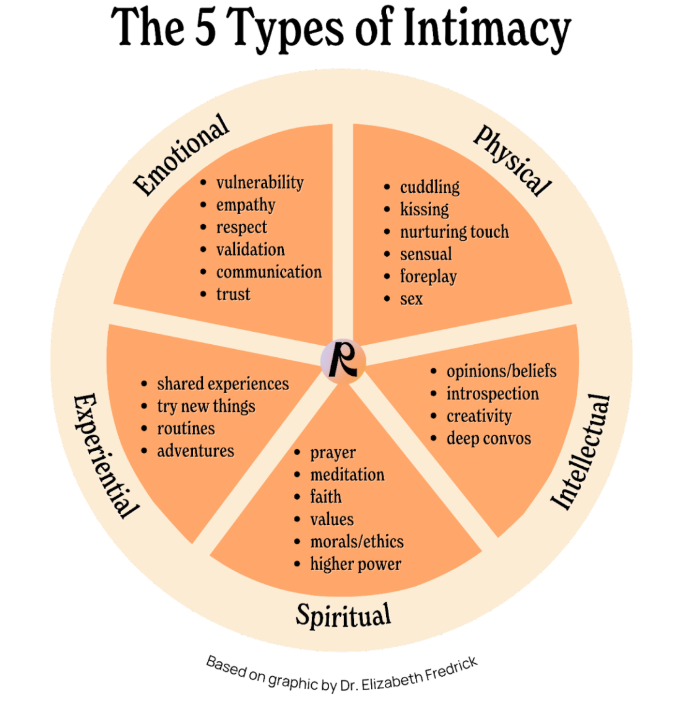
Dr. Elizabeth Fedrick holds a doctoral degree in psychology, and a master’s degree in professional counseling. She’s a specialist in assisting couples in physical and emotional intimacy, communication skills, relationship barriers and helps couples break down toxic and dysfunctional relational behaviors. We all know this, but she states the most common problem, is that humans and relationships are extremely complex and require continuous effort and attention. She has broken down and defined intimacy into 5 categories, each with their own sub-points:
- Spiritual intimacy the connection that arises from shared beliefs, values, and spiritual experiences
- Emotional intimacy the connection between partners based on shared feelings and emotional support
- Experiential intimacy the shared experiences and memories that strengthen the bond between partners
- Physical intimacy the physical connection and closeness between partners, often involving touch and physical proximity
- Intellectual intimacy the intellectual exchange and exploration of ideas and perspectives that enhance understanding and connection. These types of intimacy require effort and attention to foster and maintain healthy relationships
Dr. Elizabeth Fedrick says its vital for couples to focus on all 5 categories holistically, rather than just the emotional and physical aspects, “spend some time exploring how you can shift your efforts and attention to include intellectual, experiential, and spiritual intimacy as well.” Take a look at the intimacy chart below and the relevant points listed for each of the 5 intimacy types.
Ok double dare challenge time: 🙉 Yip, you guessed it, time to put some effort in as a couple, and work on your intimacy holistically! You’ve got nothing to lose and everything to gain don’t you agree? The #keekimonki ‘s suggest first making time for each other, to have a “deep convo”, obviously once the kids are asleep and when convenient; then grab a beverage, put your feet up and get comfy on the couch! Right, all set, perfect you’ve already ticked off one of the points lol… Now where to begin, go through the 5 categories to familiarize yourselves by checking out each point. If you are not sure what they mean then pop them into your search browser, to get the exact meaning. Maybe start small and choose one point from each category to discuss in depth, and how it can mutually benefit both of you… to ultimately bring you closer, and boost your bedroom intimacy? And if you feel like sharing, all the #keekimonki ‘s would love to hear your thoughts in the comment section down below.
In Part 2 coming soon… we’ll dive into some spicy ways to get you riding bare back again, on a more regular basis… Sneak peek 🙊
Disclaimer: This Blog does not represent relationship advice in any way, shape or form. #rebrpharm always advises, you research a topic from multiple sources. And always contact a registered relationship practitioner if you have any relationship issues, questions or concerns.
Research sources:
https://www.britannica.com/topic/intimacy
https://worldmetrics.org/sex-in-marriage-statistics
https://www.thezoereport.com/wellness/5-types-of-intimacy
https://iu.mediaspace.kaltura.com/media/t/1_oj1sfit4/176699641
https://www.connectedcouples.app/blog/how-often-do-couples-have-sex
https://grokipedia.com/page/national_survey_of_sexual_health_and_behavior
Cognitive, Affective, and Behavioral Attitude Components Explained
https://spsp.org/news-center/press-release/couples-who-have-sex-weekly-are-happiest


Very informative article, and I love the way the facts are given in such an easy to understand and authentic way. I have definitely learnt something and look forward to Part 2.
Hey thanks for your comments, Sherrie, look out for Part 2 dropping soon 😉